The Search Revolution: From Links to Logic
The search landscape is undergoing a violent transition. We have officially moved beyond the era where success was measured by a list of “ten blue links.” In 2025–2026, the primary gateway to information has shifted from traditional Search Engines to Generative Engines and Answer Engines.
This is the era of the “Dark Funnel”—a phenomenon where users find, research, and evaluate your brand through AI-synthesized answers without ever clicking through to your website. If your brand is not part of the AI’s synthesized response, you are effectively invisible. The stakes are immense: AI-referred sessions have jumped by 527% in a single year, while traditional search volume is projected to drop by 25% by the end of 2026.
Visibility today is no longer about keywords; it is about Retrieval-Augmented Generation (RAG). While AI models have “parametric memory” (what they learned during training), modern search assistants use RAG to retrieve real-time data from the web, score it for credibility, and synthesize it into a final answer. To survive this shift, brands must move from optimizing for “rankings” to optimizing for “Share of Model.”
Decoding the Trinity: SEO vs. AEO vs. GEO
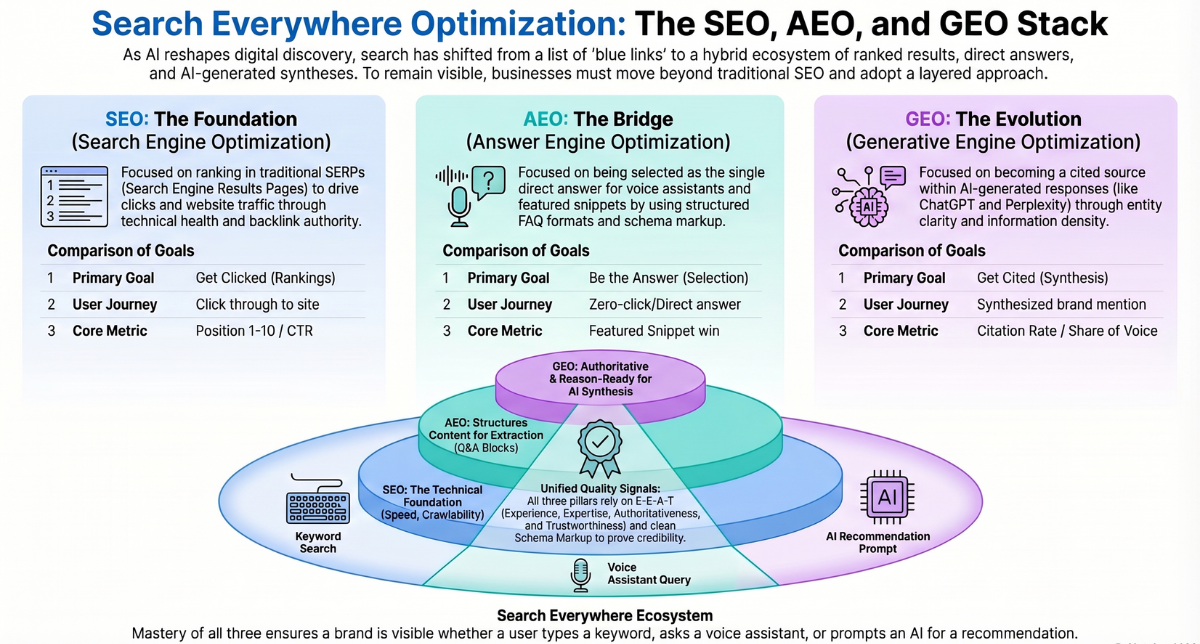
Navigating this revolution requires an integrated architectural approach. While these strategies overlap, they serve distinct roles in the retrieval and synthesis pipeline.
The Three Pillars of Modern Visibility
Pillar | Definition | Primary Goal | Success Metric | Retrieval Source |
SEO | Optimizing for traditional ranking algorithms (Google, Bing). | Baseline eligibility and high organic ranking for clicks. | Keyword Rankings & Organic Traffic | Traditional Web Index |
AEO | Structuring content to be the direct answer for voice and snippets. | Selection as the “Position Zero” answer for direct consumption. | Selection Rate & Featured Snippet Wins | Featured Snippets / Knowledge Graph |
GEO | Optimizing for citation within Large Language Model (LLM) syntheses. | Synthesis and citation as a trusted source in AI responses. | Citation Rate / Share of Model | Real-time RAG / Bing Index |
Why All Three Matter: The Convergence Strategy
It is a strategic error to view these as competing lanes. Instead, they function as a stack where SEO serves as the foundation. Without technical SEO health, AI crawlers (like GPT Bot and Perplexity Bot) cannot ingest your data. However, SEO alone is no longer a leading indicator of success.
An integrated strategy is mandatory because:
- SEO maintains the indexability of your site, ensuring your data is available for retrieval.
- AEO captures the “zero-click” market—voice search and featured snippets—which now dominate over 50% of informational queries.
- GEO ensures your brand is the cited authority when LLMs synthesize complex answers. Winning a citation is the new “Position 1,” serving as a form of brand endorsement that traditional links cannot match.
The Window of Opportunity: The Competitive Advantage
The market is currently in a state of divergence. Research indicates that only 11% of domains are cited by both ChatGPT and Perplexity. Because these platforms utilize different citation logic and retrieval systems, most businesses are unintentionally invisible on one or both platforms.
This creates a high-stakes window of opportunity. The GEO market is projected to reach $33.7 billion by 2034. By implementing a cross-platform strategy now, your business can own the citation share before the market reaches a saturation point. Those who optimize today will “own the mindshare” as the leading authorities in the AI’s knowledge graph.
- Platform-Specific Intelligence
AI engines do not reward content in a uniform way. To maximize “Share of Model,” your content must satisfy the specific extraction logic of the major players:
- ChatGPT
- The Bing Factor: A staggering 87% of SearchGPT citations match Bing’s top 10 results, compared to only 56% for Google. Claiming Bing Webmaster Tools is now a non-negotiable GEO requirement.
- Recency Bias: 76.4% of ChatGPT citations are from pages updated within the last 30 days. Static content is dead; a “living content” strategy is required.
- Extraction Logic: ChatGPT favors clean, Wikipedia-style authority and targets the first 150–300 words of a page for synthesis.
- Perplexity
- The First Measurement Win: Perplexity is currently the only engine providing measurable referral traffic directly in GA4. It functions as a pure RAG engine, valuing real-time semantic clarity.
- Community Signals: It places high value on “Information Gain” and community validation from platforms like Reddit.
- Logic: Rewards niche expertise and definitive factual statements over marketing-heavy prose.
- Google Gemini / AI Overviews
- YouTube Dominance: YouTube is now the most-cited domain in Google AI Overviews. Text-only strategies are failing; Gemini prioritizes video transcripts and multi-modal content.
- Multi-Modal Lift: Integrating text, images, and video increases selection rates by up to 317%.
- E-E-A-T: Relies heavily on Experience, Expertise, Authoritativeness, and Trustworthiness signals verified through Google’s legacy Knowledge Graph.
Five Strategic Steps to Own AI Discovery
To transition your digital presence for 2026, implement this roadmap immediately:
- Lead with the Answer (The 150-Word Capsule)
Adopt an “Answer-First” structure. Ensure the direct response to a query is contained within the first 150–300 words of your page. This satisfies the extraction logic used by ChatGPT and Perplexity, which score the beginning of a document most heavily for citation eligibility.
- Add Factual Weight
AI models prioritize “grounding” their answers in verifiable data. Incorporating statistics and expert quotations boosts AI visibility by up to 40%. Use definitive language (“The result is X”) rather than hedging (“Y might be a factor”), as synthesis models prefer extractable, citable claims.
- Implement the llms.txt Standard
Host a Markdown-based llms.txt file at your root directory. This acts as a machine-readable roadmap that helps AI bypass messy HTML and JavaScript bloat. For ecommerce and data-heavy sites, ensure this file points to structured product feeds (JSON/CSV) to provide AI assistants with the “canonical truth” of your inventory and pricing.
- Adopt Question-Based Formatting
Rephrase H2 and H3 headers as natural-language questions (e.g., “How does X work?”). Pages structured this way are cited 3.2x more often than standard informational content. This mirrors conversational intent and allows AI engines to map your content to user prompts with higher recall.
- Anchor Your Entity Clarity
AI engines use “Entity Resolution” to determine if your brand is a trusted authority. Ensure your brand name, leadership titles, and expertise are identical across LinkedIn, industry directories, and your website. Use the “sameAs” array in your Organization or Person Schema (JSON-LD) to technically anchor these profiles, providing the AI with the confidence to recommend you.
- Conclusion & The Radstone AI Marketing Audit
In 2026, visibility is no longer a game of clicks; it is a battle for Citation Authority. If an AI engine cannot verify your entity or extract your data, your business effectively does not exist in the future of search.
Is your business ready to be recommended, cited, and found?
Contact Radstone AI Marketing today for a comprehensive AI Discovery Audit.
Our tream will perform a deep-dive analysis of your Entity Consistency, identify critical Citation Gaps, and evaluate your Share of Model to ensure your brand dominates the next generation of discovery.